CGI, AI & Digital Commerce: the new rules of visual trust online
In late 2022, generative AI became a global phenomenon, slowly taking the world by storm. At that time, the biggest question was whether AI could generate good images. Today, however, the more pressing question remains whether the audience can trust those images.
With generative AI branding coming into play, brands have started approaching content creation differently. Earlier, product visuals required days and months of planning before going ahead with the execution. Now, with images being generated within a few minutes, has led many to believe that CGI product visualization and premium visual content have become assets.
Ironically, the opposite is true.
Since everyone today has easy access to AI tools, consumers are far more adept at spotting details of imagery produced in front of them. As a result, distinguishing real from artificial or inconsistent is not rocket science anymore. Whether it is 3D rendering for brands, product aesthetics or campaign assets, audiences are paying closer attention to the smaller details than ever before. Which means AI in post-production has become far more important.
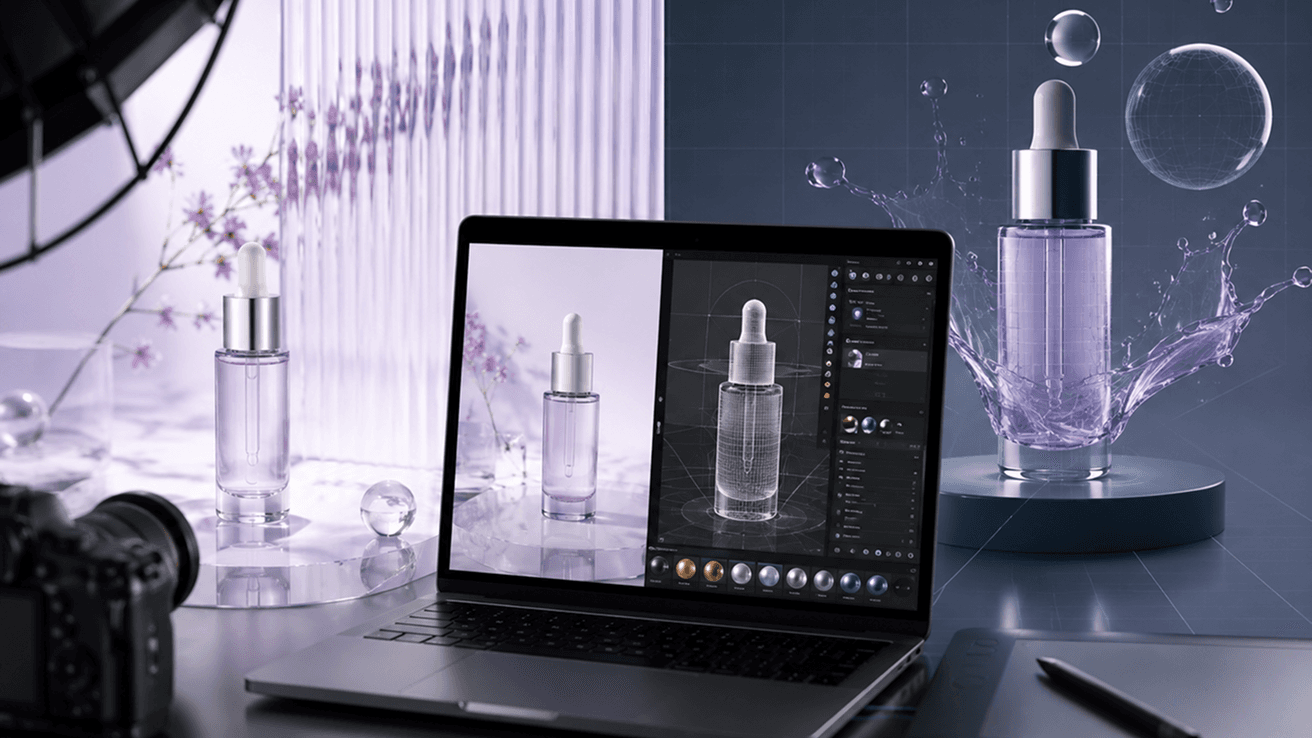
1: Traditional photography comes with its physical limits
Beyond just what's inside the product, luxury is also about how the product feels before a consumer even touches it. Industries like fashion and beauty find that challenging because materials and textures behave erratically, making it difficult for traditional photography to capture it in one go.
Materials such as glass, metal, gemstones and liquids interact with light from different angles in complex ways, making CGI vs photography an increasingly relevant conversation for today's evolving brands.
Take for example, a diamond bracelet that catches light from multiple angles, or a liquid foundation where the hero of the story is hydration, not heaviness.
These are complex products to capture on camera as they constantly interact with light, no matter where they are placed. Reflections, microscopic textures, and fluid dynamics often require multiple takes. Every shot needs special lighting and retouching until it looks flawless to achieve the desired result.
This is where CGI product visualisation comes into play, more as a commercial advantage than a creative outlet. When technical accuracy meets artistic control, it enables brands to create imagery that remains consistent throughout their campaigns, launches and 3D visualisation for e-platforms. What photography alone cannot do CGI product visualisation masters it. Whether it is luxury product CGI for refined accessories or beauty CGI rendering for cosmetics, advanced 3D rendering for brands enables brands to highlight products with remarkable accuracy while maintaining complete creative control.
2: Consumers aren't aware of CGI. But they know when something looks fake.
Most often, the purpose of CGI is confused with perfection. However, the objective of CGI is not to make a photo look perfect or flawless. In fact, its job is to make it look believable to the consumer.
The subtle technical details distinguish average and premium CGI – something that consumers may not notice consciously, but could respond to intuitively.
Details such as natural reflections and accurate textures are what separates hyper-realistic and convincing CGI from imagery that falls into the "uncanny valley" - where something appears to look real, but not quite enough to inspire assurance.
For beauty and luxury brands, this difference matters because premium products usually rely on visual trust. When a digital asset of the brand feels artificial, consumers may not fully trust the quality of the product itself.
The most convincing 3D rendering for brands doesn't announce itself as CGI. It simply gives consumers the quality they wish to see.
3: AI isn't replacing post-production. It is working in parallel with it.
Most people believe that generative AI has replaced post-production. This does not stand true.
Because while AI is great at providing teams with an abundance of creative ideas for a believable kickstart, it struggles when it comes to precision. Elements such as typography, brand colours, packaging accuracy, premium detailing and structural consistency can only come to life with human expertise. And these are the elements that protect a brand's identity; hence, they cannot be left to AI alone.
So, how can AI work in parallel to post-production?
The ideal way to create a win-win situation is to marry the speed of AI automation with the expertise of professionals who understand composition, colour fidelity, retouching, and brand consistency.
AI can create infinite possibilities. However, only expert post-production can build confidence.
4: Re-evaluate budget distribution
Brands set aside about 95% of their budget for production costs, such as photography, shoot planning and execution. The remaining 5% is for post-production. This budgeting model needs to be re-evaluated, especially if you want your consumers to remember the final imagery. Because, to be honest, consumers do not care how many cameras were used to shoot a particular product or campaign. All they care about is how visually appealing it looks in post-production.
With AI reducing the cost of content creation, it only makes sense to use that amount in investing strategically in CGI and post-production. This will ensure that the final product the consumers see feels unmistakably believable and on-brand.
AI has changed the content creation process, yes. What it hasn't changed is how consumers perceive the quality.
An effective strategy gets your brand talking. Production captures the raw material.
However, in an increasingly AI-generated digital world, seamless post-production transforms those assets into experiences that leave an impression.
As AI reforms visual content, the brands that get noticed will be those that combine automation with expertise. Discover how Manipal Digital's CGI & 3D Visualisation services help convert ideas into hyper-realistic experiences that inspire confidence across every digital touchpoint.
